Updated September 2026. We first published this in March, when $150 per 5 lb was a forecast. Six months on, the first half of it has arrived — and the industry has started shrinking the tub as well as raising the price. This article has been rewritten with current figures.
In March we wrote that a 5 lb tub of quality whey isolate could approach $150 USD within 12–18 months. That forecast is now half spent. Every whey isolate we stock has crossed US$100 per 5 lb — and it is still cheaper here than on the brands’ own American websites. Raw whey isolate trades above $12 a pound, most suppliers are sold out through the end of the year, and they are forecasting another 20–30% before 2027. Something else has changed too, and it is easier to miss: the tub itself is getting smaller.
The Demand Explosion: Protein Is the New Gold
For years, whey protein was primarily the domain of bodybuilders and serious athletes. That era is over. Today, protein has become a mainstream nutritional priority — and the demand is coming from every direction simultaneously.
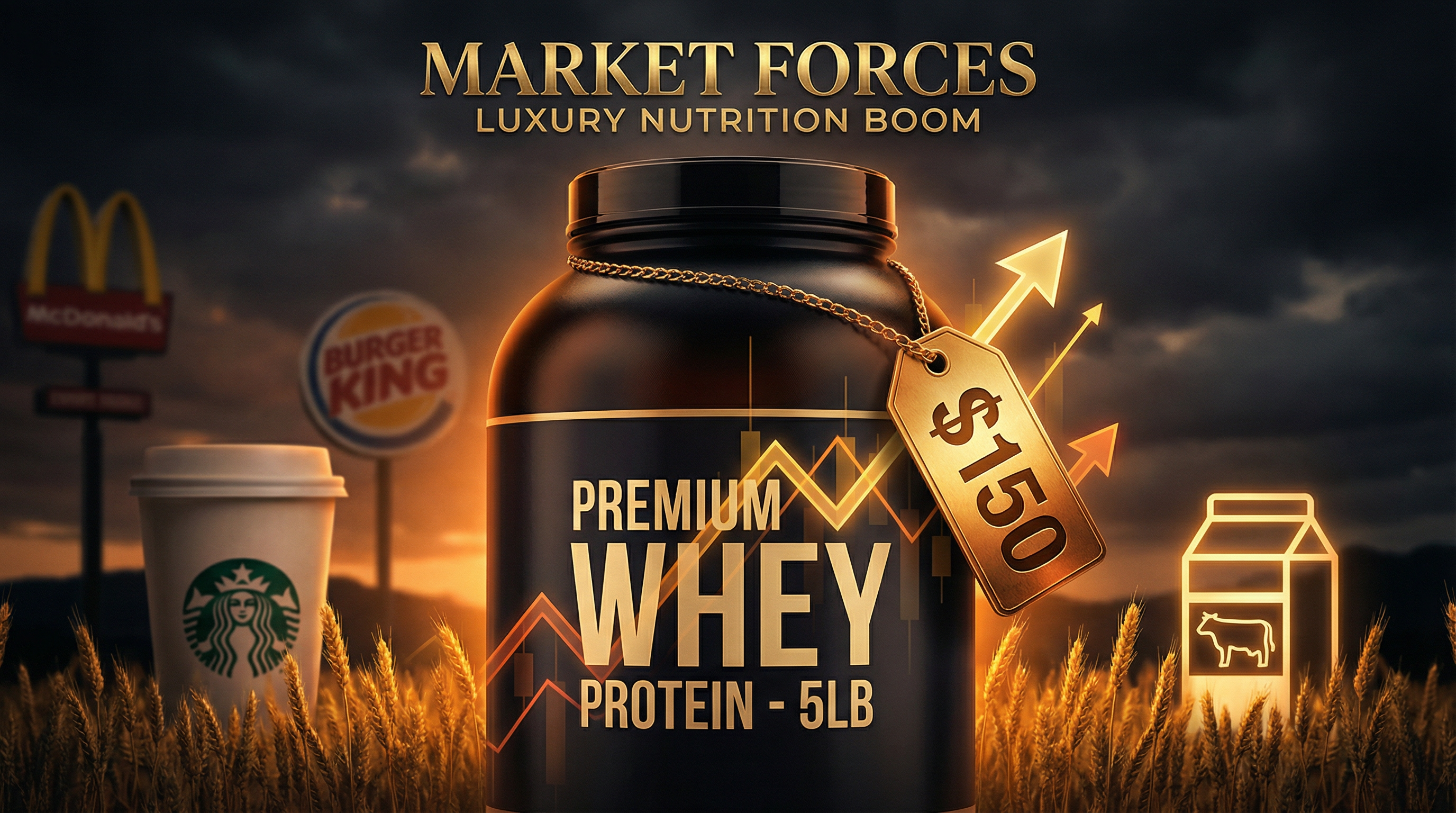
Starbucks, Kellogg's, McDonald's, and dozens of other global food giants have begun fortifying their products with whey protein. When Starbucks integrates dairy protein permanently into its menu across tens of thousands of locations worldwide, it pulls enormous volumes of raw whey concentrate out of the supply chain — volumes that previously went to supplement manufacturers. The result is a direct squeeze on the ingredient pool that your protein powder is made from.
Simultaneously, the widespread adoption of GLP-1 medications such as Ozempic and Wegovy has created an entirely new category of protein demand. Approximately 12% of the US population is now using these drugs for weight management. Because users can lose 25–40% of their total body weight as lean muscle mass, physicians are prescribing significantly higher daily protein intake — and whey remains the gold-standard recommendation. This medically driven demand has layered on top of existing consumer trends, creating a surge the supply chain was never built to handle.
The Protein Arms Race: How a Weight-Loss Drug Ended Up in Your Cereal
To understand why a tub of whey costs what it does, look at two things at once: what is happening to appetite, and what is happening in the supermarket aisle. The GLP-1 story did not stop at Ozempic. The next generation, retatrutide, acts on three hormone receptors at once — GLP-1, GIP and glucagon — and in trials produced weight loss well beyond anything semaglutide achieved. It is not yet approved anywhere. That has not stopped it. It already circulates through grey-market “research peptide” channels, used undocumented, with no prescription and no count of how many people are on it. The one thing every user reports is the same: they eat far less, and the first thing to go is the food that was engineered to be hard to stop eating — crisps, biscuits, sweets, fast food.
That is an existential problem for the companies whose profits were built on exactly that food. When your customer is eating half as much and dropping the junk first, you have two choices: lose them, or make your product something they still reach for. The industry’s answer is on every shelf. Chocolate with added protein. Crisps with added protein. Frozen pizza, yoghurt, breakfast cereal, ice cream, bread — almost anything you pick up now carries a “+PROTEIN” flash on the front. The logic is simple: someone who eats little wants every bite to count, and protein is the one nutrient they have been told to protect. Fortifying the product is how ultra-processed food stays buyable to a customer who no longer wants it.
Read the back, not the front: 25 g per pack is not 25 g per serving
Here is the sleight of hand. A scoop of whey protein delivers 20–25 g of pure protein in one serving. A “+PROTEIN” cereal or snack typically adds 3–8 g per serving — and prints a much bigger number on the front, because that number is for the whole bag, the whole pot, the whole pizza. “25 g protein” on a family pack of crisps is a few grams in the bowl you actually eat. Same raw ingredient. A fraction of the dose. Only the marketing is full-strength.
| Product | Front of pack says | What one serving gives you | Versus a scoop |
|---|---|---|---|
| Whey isolate, 5 lb tub | 25 g per scoop | 25 g pure protein | the benchmark |
| “+Protein” breakfast cereal | “20 g protein” per 100 g | 4–6 g in a 40 g bowl | about one-fifth |
| “+Protein” yoghurt pot | “15 g protein” per pot | 10–15 g | about half |
| “+Protein” chocolate bar | “20 g protein” per bar | 8–10 g per bar | about one-third |
| “+Protein” crisps, family bag | “25 g protein” per bag | 4–5 g per handful | about one-sixth |
Typical label values across the category; check the nutrition panel of any specific product.
Now multiply those few grams by tens of thousands of product lines and hundreds of millions of shoppers. That is the demand explosion the whey market is choking on. Each fortified product needs only a little whey — but there are suddenly an enormous number of them, and together they are pulling more protein out of the supply chain than every gym in the world combined.
Why the tub on the shelf pays the highest price of all
This is where it lands on you. A fortified cereal does not need the good stuff. A few grams of protein per serving can come from lower-grade concentrate, milk protein, pea or soy, blended and flavoured until nobody can tell. A sports supplement cannot do that. A tub sold as whey isolate has to be WPI 90 — ninety percent protein by weight — and a concentrate has to be WPC 80. These are the top fractions of the whey stream: the most expensive to filter and dry, and the ones with the least processing capacity behind them. And they are exactly the fractions the food giants have started competing for, because “whey protein isolate” on a cereal box sells better than “milk protein concentrate”.
The arithmetic is brutal. A 5 lb tub of isolate is roughly 2 kg of WPI 90 — 76 servings of 25 g each. A box of “+protein” cereal uses perhaps 40 g of whey across the entire box. One tub of your protein contains the whey of fifty boxes of fortified cereal. When the cereal maker and the supplement maker are bidding for the same dairy plant’s isolate, the product that needs two kilograms of it per unit is the one whose price moves first, moves most, and has nowhere to hide it — no blend, no filler, no smaller scoop. That is why the purest protein on the shelf is also the one whose price has climbed the fastest, and why it will keep climbing until new processing capacity arrives in 2027.
The Real Bottleneck: Processing Capacity, Not Milk
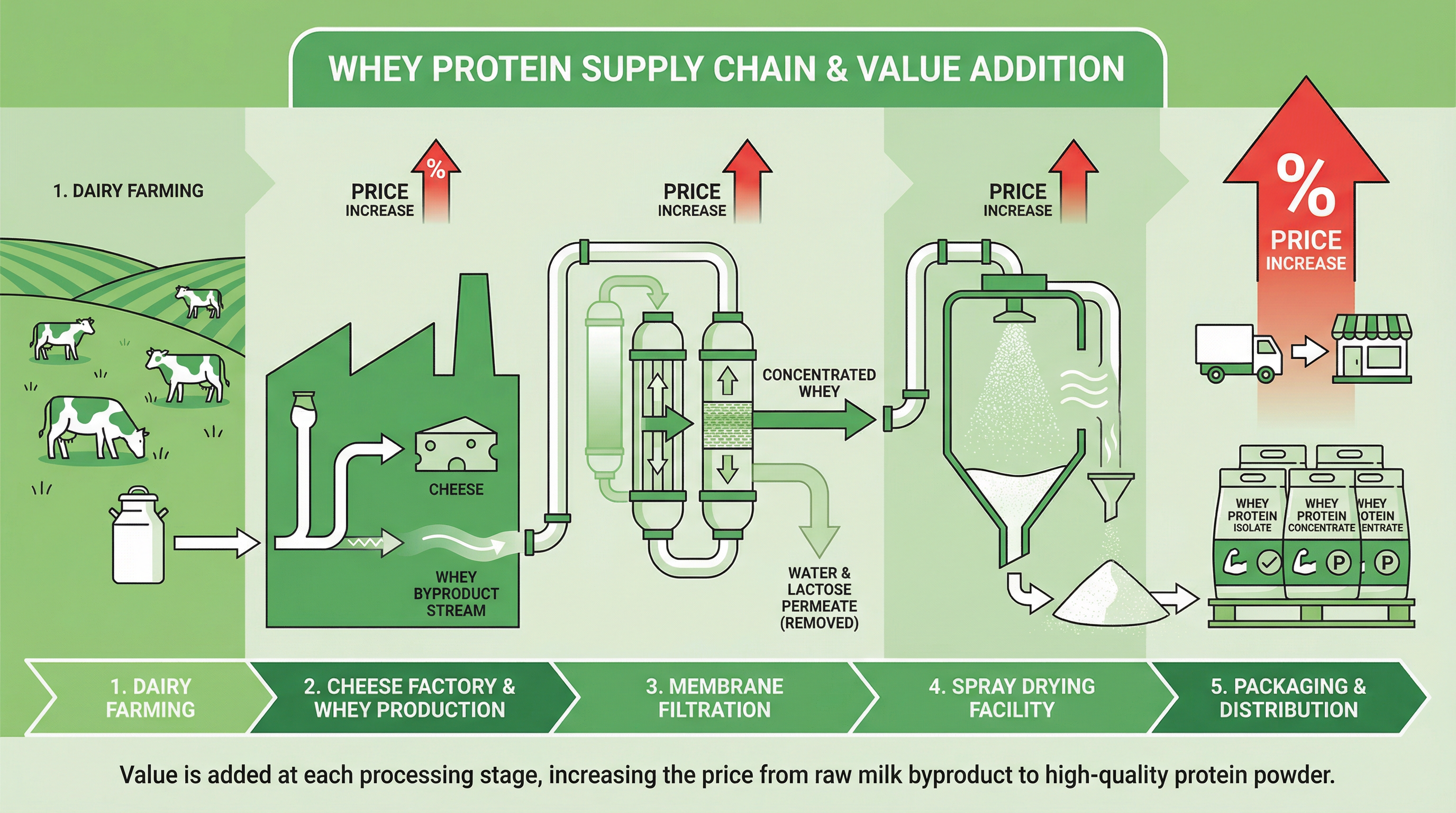
A common misconception is that rising whey prices are caused by a shortage of milk. In reality, global dairy production remains stable. The problem lies downstream in the processing chain. Whey is a byproduct of cheese manufacturing. It must be filtered, concentrated, and spray-dried into whey protein concentrate (WPC) or whey protein isolate (WPI) — processes that require expensive, specialised membrane filtration systems and spray-drying towers that take years and hundreds of millions of dollars to build.
Most of the world's major processing facilities are already running at or near full capacity. Major dairy companies including Glanbia, Tirlán (€126 million investment), and Idaho Milk Products ($200 million investment) are building new capacity — but none of these expansions will deliver meaningful new supply until 2027 at the earliest — Glanbia’s new isolate capacity arrives via a New Mexico joint venture in 2027, and Tirlán’s plant is dated mid-2027. In the meantime, raw whey protein concentrate (WPC80) now trades above $11 per pound and isolate (WPI) sits in the $12s — levels never previously seen in the market, with many suppliers already sold out for the remainder of 2026.
Think about what that means for a finished product. If raw WPI alone costs $12 per pound, and a 5 lb jar contains 5 lbs of raw material, that is $60 in raw ingredient cost alone — before manufacturing, flavouring, packaging, shipping, import duties, and retail margin are added. That is why $150 per 5 lb jar is no longer a warning about the future; it is where the market is heading in the first half of 2027.
The Price Red Flag: When Cheap Whey Is Too Cheap to Be Real
Here is where things get dangerous for consumers. As whey prices rise to commodity-level scarcity — comparable to gold or oil in terms of supply constraints — a parallel market of counterfeit, adulterated, and amino-spiked protein powders has exploded. Understanding this is critical before you buy any protein product, especially online or from unverified sources.
The mathematics are simple and unforgiving: if the global wholesale price of raw whey protein isolate is approximately $11–12 per pound, then a finished 5 lb product cannot legitimately be sold for $60 USD. The raw material alone would cost more than the selling price. If you see a 5 lb tub of "whey isolate" priced under $70, one of the following is almost certainly true:
- The product contains little to no actual whey protein isolate
- It is heavily blended with cheap pea protein, rice protein, or soy protein
- It is amino spiked with cheap non-protein nitrogen sources
- It contains collagen peptides disguised as whey protein
Amino Spiking: The Supplement Industry's Biggest Scam
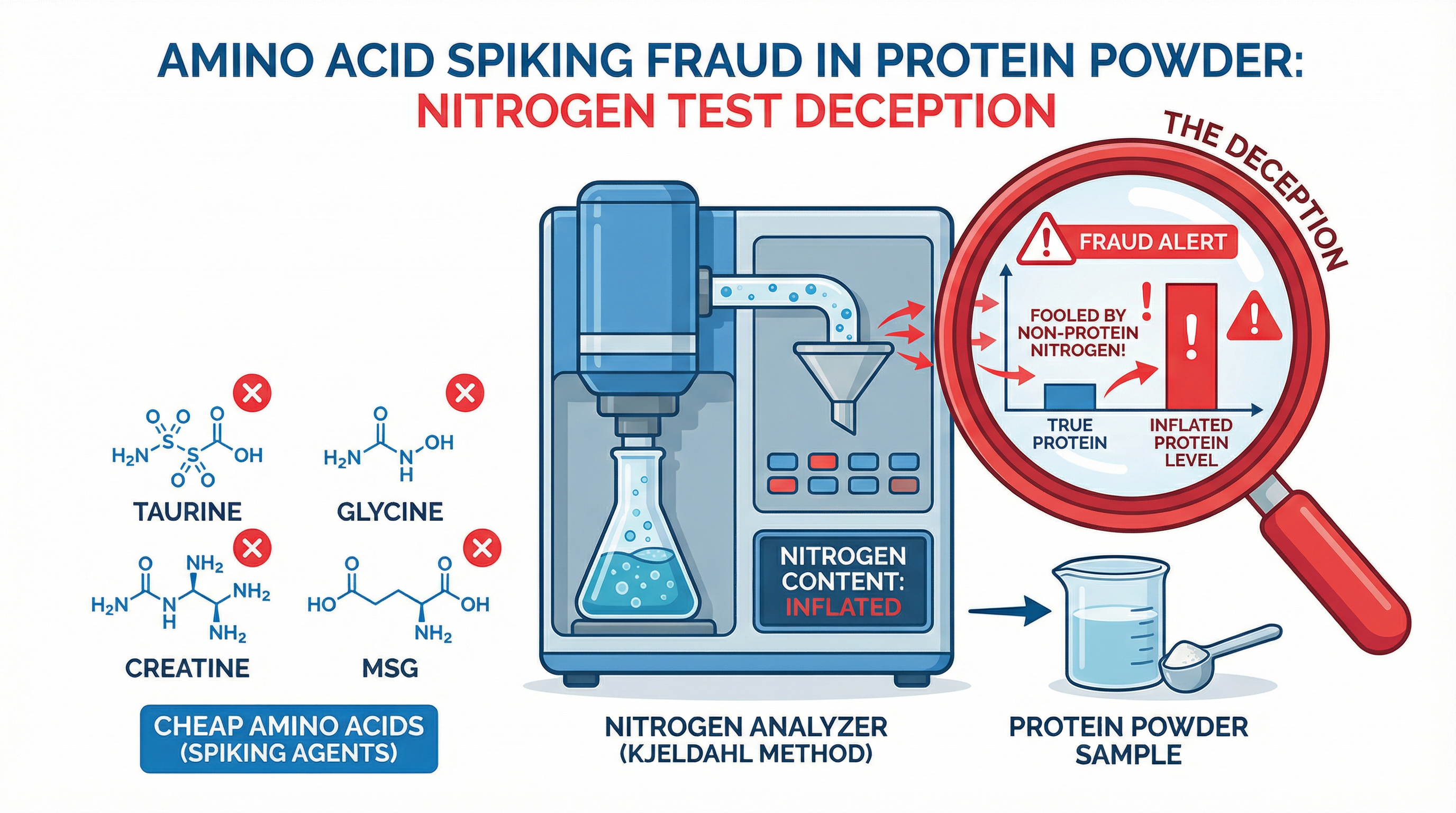
Amino spiking — also called protein spiking or nitrogen spiking — is a fraudulent practice where manufacturers add cheap, non-protein amino acids or nitrogen-containing compounds to their powder to artificially inflate the protein reading on a standard nitrogen test (the Kjeldahl method). The test cannot distinguish between protein-derived nitrogen and nitrogen from other sources, so the label reads "25g protein" when the actual muscle-building protein content may be as low as 10–15g.
The most commonly used spiking agents include:
- Taurine — a sulphur-containing amino acid that is extremely cheap and contains nitrogen
- Glycine — the simplest amino acid, often sourced from collagen hydrolysate, costs a fraction of whey
- Creatine — a nitrogen-containing compound that inflates nitrogen readings but provides no protein
- Glutamine — cheap standalone glutamine added in bulk to inflate numbers
If you see any of these listed as separate ingredients in the amino acid profile of a protein powder — rather than as part of the naturally occurring amino acid spectrum of whey — treat it as a serious red flag.
The MSG Trick: Making Fake Protein Taste Real
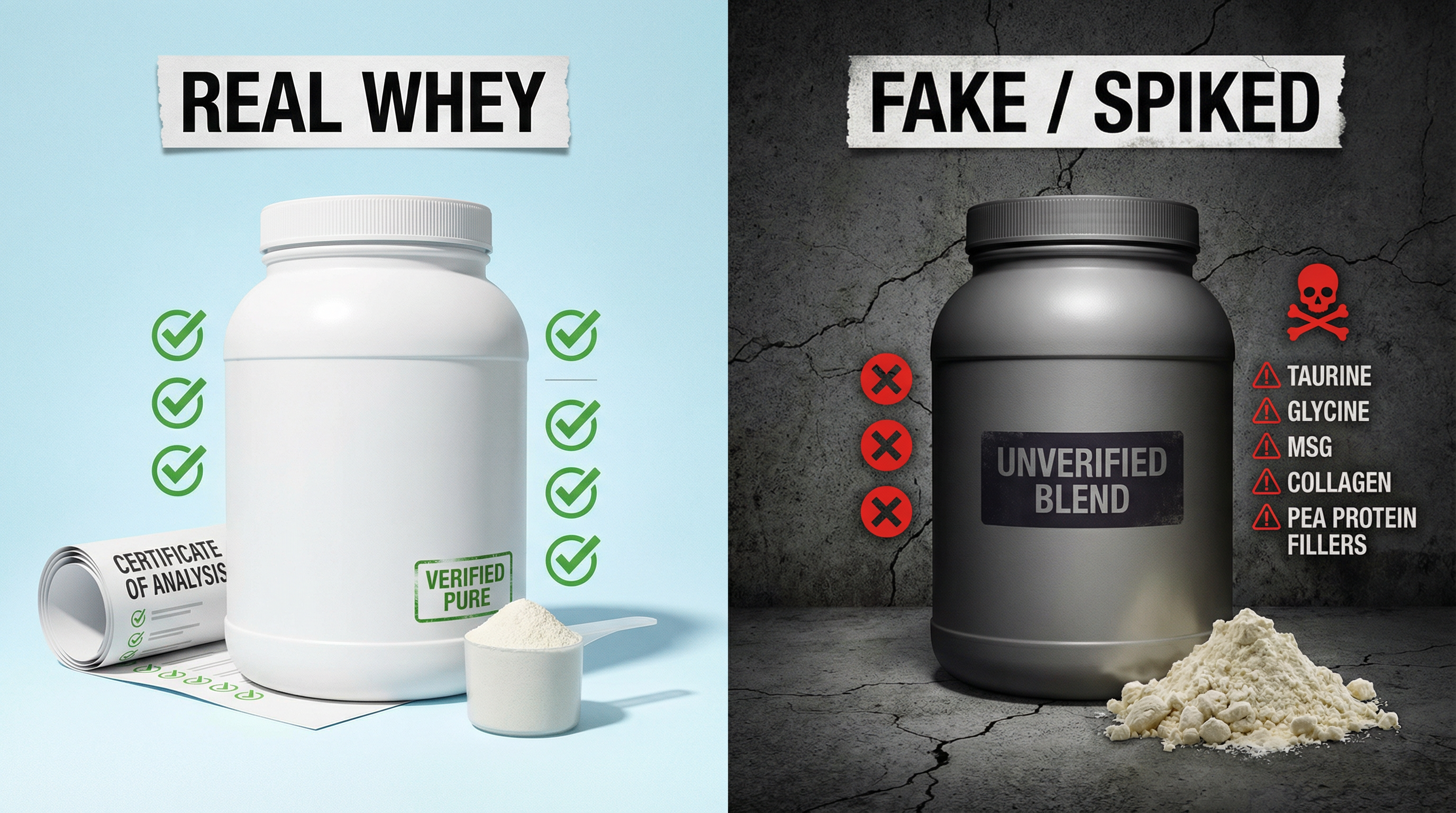
Some manufacturers have taken adulteration a step further by adding Monosodium Glutamate (MSG) to their protein powders. MSG is the sodium salt of glutamic acid — an amino acid — and it acts as a powerful umami flavour enhancer. In the context of protein powder, MSG serves a sinister dual purpose: it inflates the glutamic acid reading on amino acid panels (allowing companies to claim higher glutamic acid content, which sounds nutritious), and it makes the powder taste rich, creamy, and satisfying — mimicking the natural milky taste of genuine whey.
A consumer who has never tasted high-quality pure whey will find an MSG-enhanced fake product delicious and convincing. The texture may feel smooth, the flavour may seem authentic, and the label may show impressive numbers — but the actual bioavailable protein for muscle synthesis is a fraction of what is claimed.
Legitimate whey protein manufacturers do not need to add MSG. The natural flavour of high-quality whey concentrate or isolate, when properly processed, has a clean, mild, slightly milky taste. If a protein powder tastes unusually intense, savoury, or addictively rich without a clear flavour additive explanation, it warrants scrutiny.
The Tub Is Shrinking: The Price Rise You Cannot See
There is a second way to pass on a cost increase, and it does not show up on the price tag. Rather than move a familiar number, a manufacturer keeps the price and quietly puts less powder in the container. It is happening across the category right now, and isolate is where it landed first.
NutraBio no longer sells its Whey Protein Isolate by weight at all. The choices are 20 servings or 50 servings — no 5 lb tub exists. Its Classic Whey, which is the cheaper concentrate, still comes in a 5 lb. Dymatize has added 20- and 24-serving tubs beneath its 3 lb and 5 lb ISO100. Rule 1 now slots a 3 lb between its 1.5 lb and 5 lb. Outside whey, one UK blend went from 1.2 kg to 900 g at the same price — a 25% increase with nothing on the label to announce it.
This breaks the habit most of us shop by. A tub that looks cheaper on the shelf is often the same price per gram, or worse. Two rules protect you:
- Compare price per serving, not price per tub. Optimum Nutrition prices its own 5 lb Gold Standard at $131.99 for 73 servings — about $1.80 a serving. That is the benchmark to measure any tub against.
- Check grams of protein per serving, not just the serving count. A tub can keep its 50 servings and shrink the scoop. Twenty-five grams per serving is the standard for a real isolate; anything materially below it is a smaller product wearing the same label.
How to Protect Yourself: The Buyer's Checklist
Given the current market conditions, here is a practical checklist for evaluating any whey protein product before purchase:
| Check | Green Flag | Red Flag |
|---|---|---|
| Price | $100–150+ for 5 lb WPI, or $1.80+ per serving | Under $70 for 5 lb "isolate" |
| Tub size | Weight and servings both stated | Servings only, or a smaller tub at last year’s price |
| Ingredient list | Whey isolate as first ingredient | Taurine, glycine, creatine listed separately |
| Third-party testing | Informed Sport, NSF, or Labdoor certified | No certification, "proprietary blend" |
| Taste profile | Clean, mild, slightly milky | Unusually intense, savoury, or addictive |
| Brand transparency | Full amino acid panel published | No amino acid breakdown available |
Trusted Brands Available at MacauNutrition
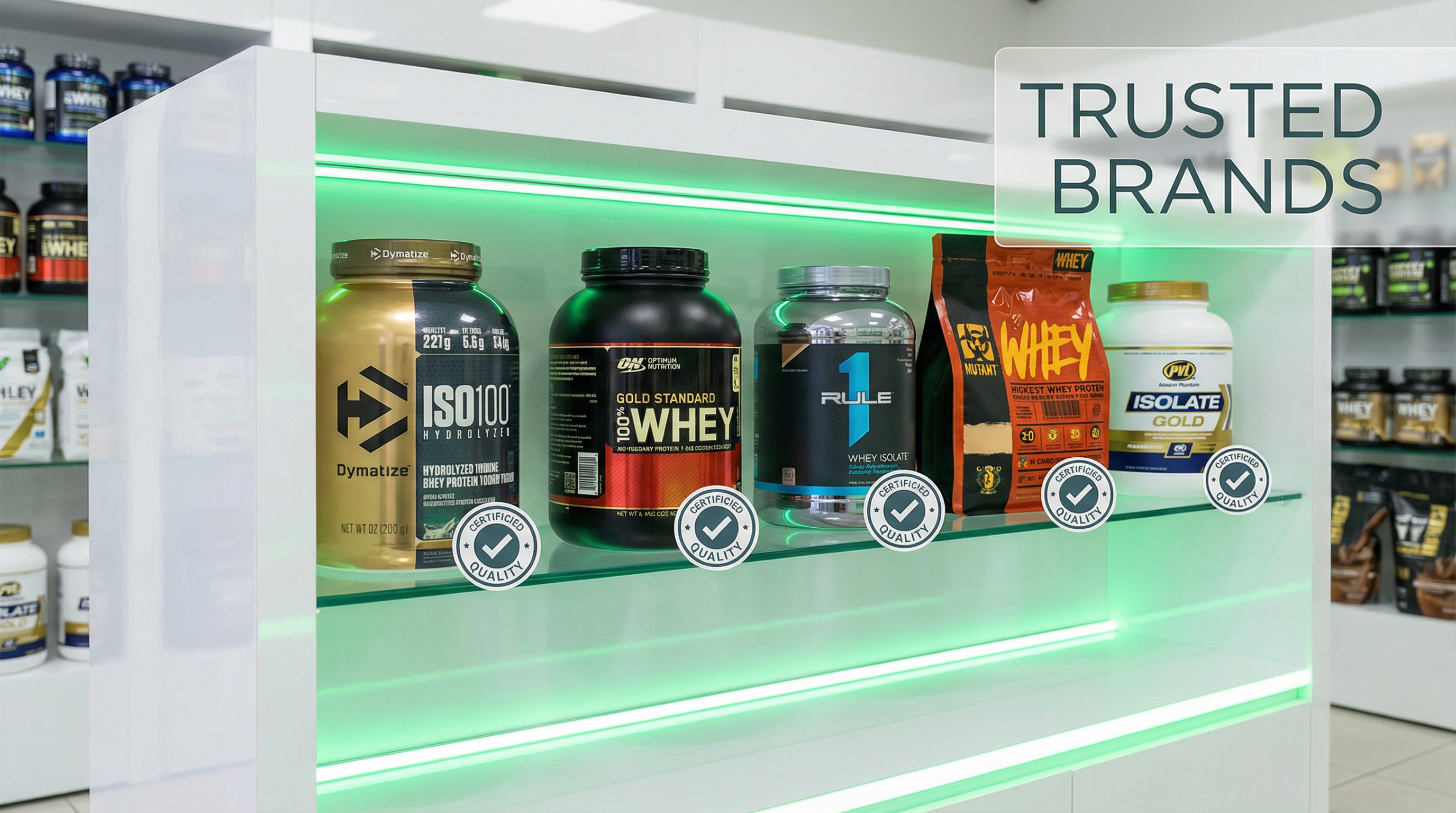
At MacauNutrition, we stock only brands with verified manufacturing standards, third-party testing, and transparent amino acid profiles. In the current market environment, these are the whey protein products we confidently recommend:
🏆 Dymatize ISO100 Hydrolyzed Whey Isolate
The gold standard of whey isolates. Hydrolyzed for maximum absorption speed, 25g protein per serving with virtually zero fat and lactose. Third-party tested and Informed Sport certified. In a market flooded with fakes, ISO100 is the benchmark.
→ Shop ISO100 at MacauNutrition🥇 Optimum Nutrition Gold Standard 100% Whey
The world's best-selling protein powder for good reason. A blend of whey isolate, concentrate, and peptides with 24g protein per serving. Manufactured by Glanbia — one of the world's largest and most trusted dairy processors. Full amino acid transparency, no spiking.
→ Shop ON Gold Standard at MacauNutrition💪 Rule 1 Whey Isolate
Rule 1 is built on a simple philosophy: no fillers, no spiking, no shortcuts. R1 Whey Isolate delivers 25g of 100% whey isolate and hydrolysate per serving. One of the cleanest labels in the industry — exactly what you need when raw material costs are at record highs.
→ Shop Rule 1 at MacauNutrition🦾 Mutant Whey
Mutant Whey is a multi-source whey blend delivering 22g protein per serving with a rich, indulgent flavour profile that is achieved through quality ingredients — not MSG. A great option for those who want excellent taste without compromising on protein quality or transparency.
→ Shop Mutant Whey at MacauNutrition⚡ PVL Isolate Gold
PVL's Isolate Gold is a premium Canadian-manufactured whey isolate with 27g protein per serving and a clean, verified label. PVL has been a trusted name in performance nutrition for over 25 years and maintains rigorous quality standards across all its product lines.
→ Shop PVL Isolate Gold at MacauNutritionWhat to Expect Through 2027
The whey protein shortage is a textbook case of demand outrunning infrastructure, and the relief has moved further away. Glanbia’s new isolate capacity now arrives through a New Mexico joint venture in 2027; Tirlán’s €126 million plant is dated mid-2027; Idaho Milk Products’ $200 million expansion is still building. Nothing meaningful lands before then.
On the demand side, what we forecast in March has already happened. The core GLP-1 patents expired in early 2026 across roughly ten countries — including China, India and Brazil — together holding about 44% of the world’s population. Indian generics launched at up to 92% below the branded price. Those users are advised to eat more protein, not less, and that demand is now permanent rather than predicted.
Wholesale whey rose again on 1 July, and suppliers are forecasting a further 20–30% before the end of 2026. Increases of that size usually reach shop shelves one to two quarters later, which points at the first half of 2027. Applied to today’s Macau prices, that is roughly MOP 1,050–1,200 for a 5 lb isolate — US$130–150, the number this article was named after in March.
For consumers in Macau and Hong Kong, the practical implication is clear: high-quality whey protein is now a premium product, and its price reflects that reality. A 5 lb isolate at US$100–125 today is not overpriced — it is correctly priced given current raw material costs. It is worth knowing what those same brands charge at home: Rule 1 lists its 5 lb Whey Isolate at $129.99 and Optimum Nutrition lists Gold Standard at $131.99 on their own US websites. Our Macau shelf price sits below both. A 5 lb tub offered under $70 should raise serious questions about what is actually inside.
The best protection is to buy from trusted retailers who stock verified brands. MacauNutrition sources all protein products directly from authorised distributors with full chain-of-custody documentation. When you buy from us, you know exactly what you are getting.
Shop Verified Whey Protein in Macau
All brands third-party tested. No amino spiking. No fillers. Free delivery in Macau on orders over MOP$650.
Browse All Protein Powders →