What Is Whey Protein and Where Does It Come From?
Whey protein is one of the most studied and effective supplements in sports nutrition — but most people have no idea where it actually comes from or how it is made. The answer starts with a glass of milk.
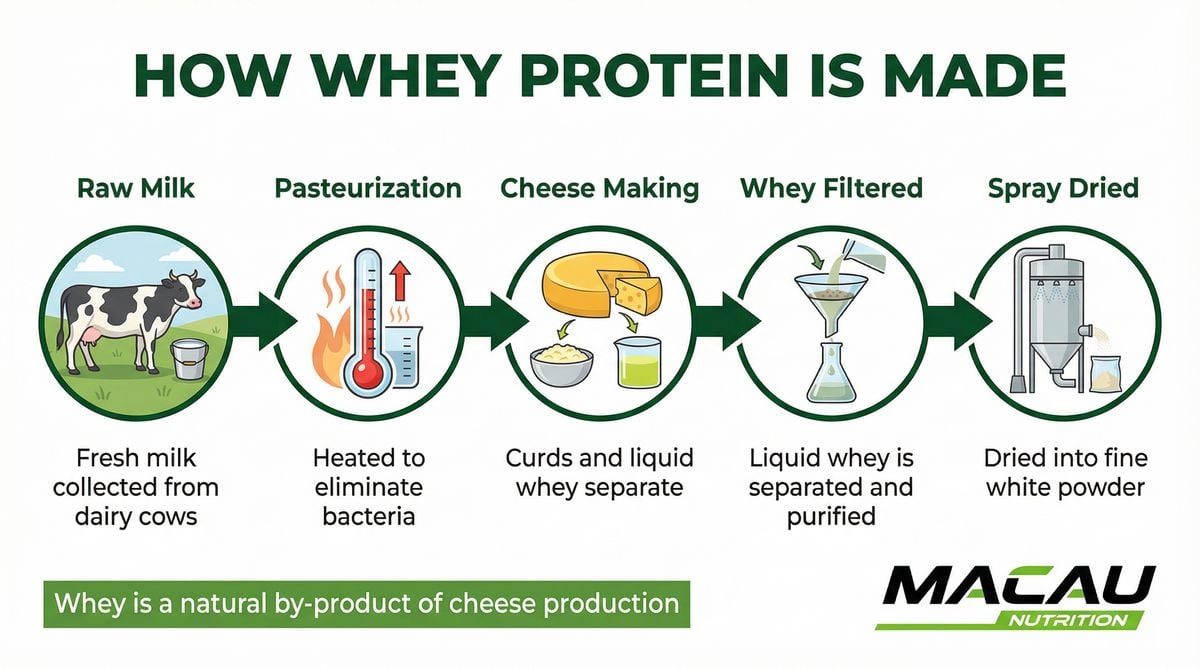
Cow's milk contains two main proteins: casein (about 80%) and whey (about 20%). When milk is processed to make cheese, an enzyme is added that causes the milk to curdle. The solid curds become cheese. The liquid that remains — the yellowish watery substance — is whey.
That liquid whey is then filtered, purified, and spray-dried into the fine white powder you scoop into your shaker. So every tub of whey protein you buy started life as a by-product of cheese production. It is a completely natural, food-derived protein source.
WPC and WPI: The Same Protein, Different Filtration
This is where most people get confused — and where supplement marketing does the most damage. Walk into any supplement store and you will see products labelled "Whey Concentrate" and "Whey Isolate" priced very differently, with isolate almost always positioned as the premium, superior option. But here is what the industry rarely tells you:
WPC and WPI are the same whey protein. The difference is only in how many times it has been filtered.
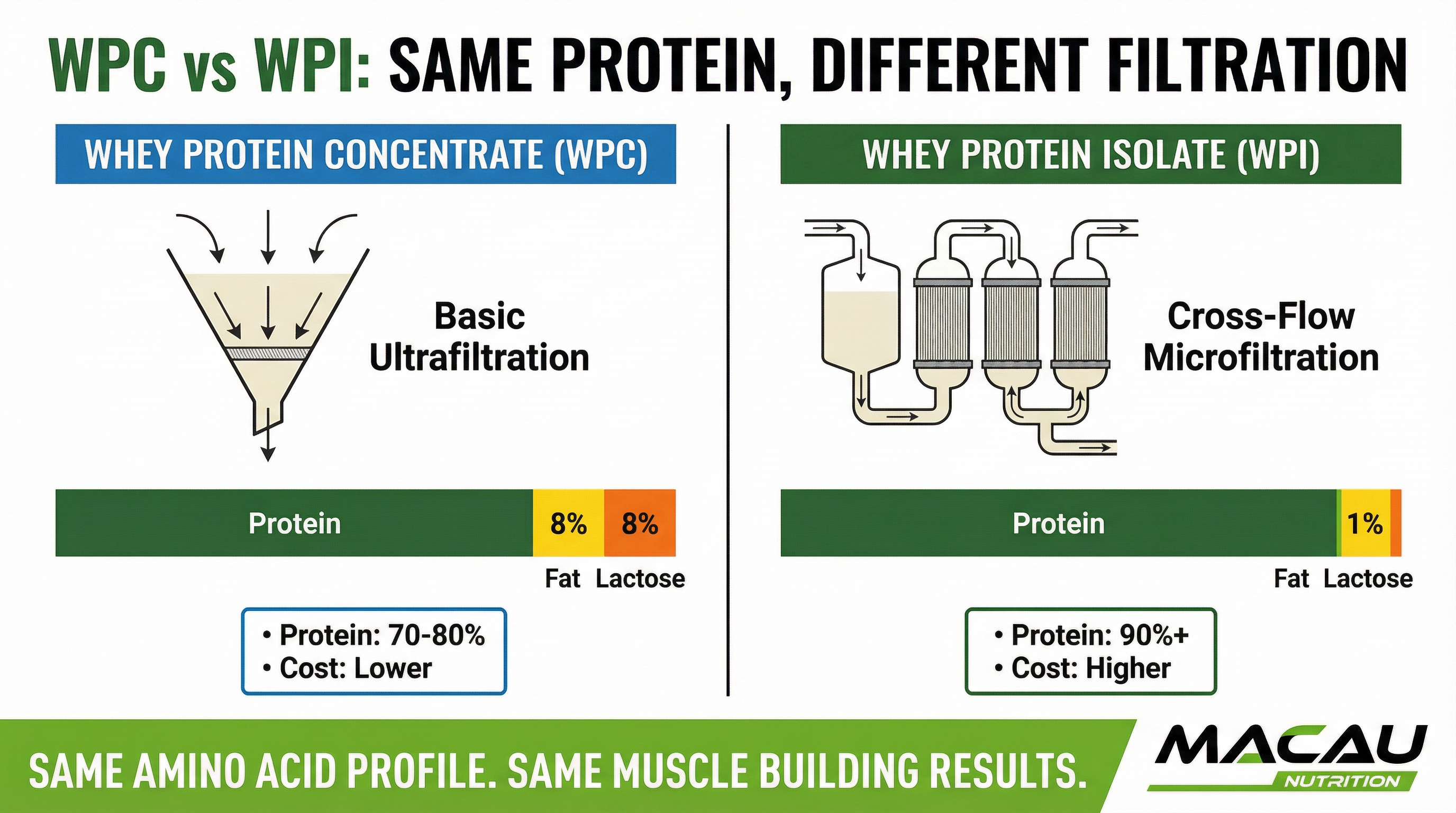
Whey Protein Concentrate (WPC) undergoes basic ultrafiltration. The result is a powder that is typically 70–80% protein by weight, with the remaining content being small amounts of fat and lactose (milk sugar).
Whey Protein Isolate (WPI) undergoes additional filtration steps — typically cross-flow microfiltration or ion exchange. This removes more of the fat and lactose, resulting in a powder that is 90%+ protein by weight.
The amino acid profile — the actual building blocks your muscles use — is identical between WPC and WPI. Both contain all nine essential amino acids. Both are rich in leucine, the key trigger for muscle protein synthesis. If you are not lactose intolerant, WPC will deliver the same muscle-building results as WPI at a significantly lower cost.
"100% Whey" Does NOT Mean 100% Protein
This is one of the most widespread misunderstandings in the supplement industry, and it costs consumers money every single day.
When a product is labelled "100% Whey Protein", it means the protein source used is 100% whey — not that the powder contains 100 grams of protein per 100 grams of powder. The number after WPC or WPI tells you the actual protein concentration of the raw material used.
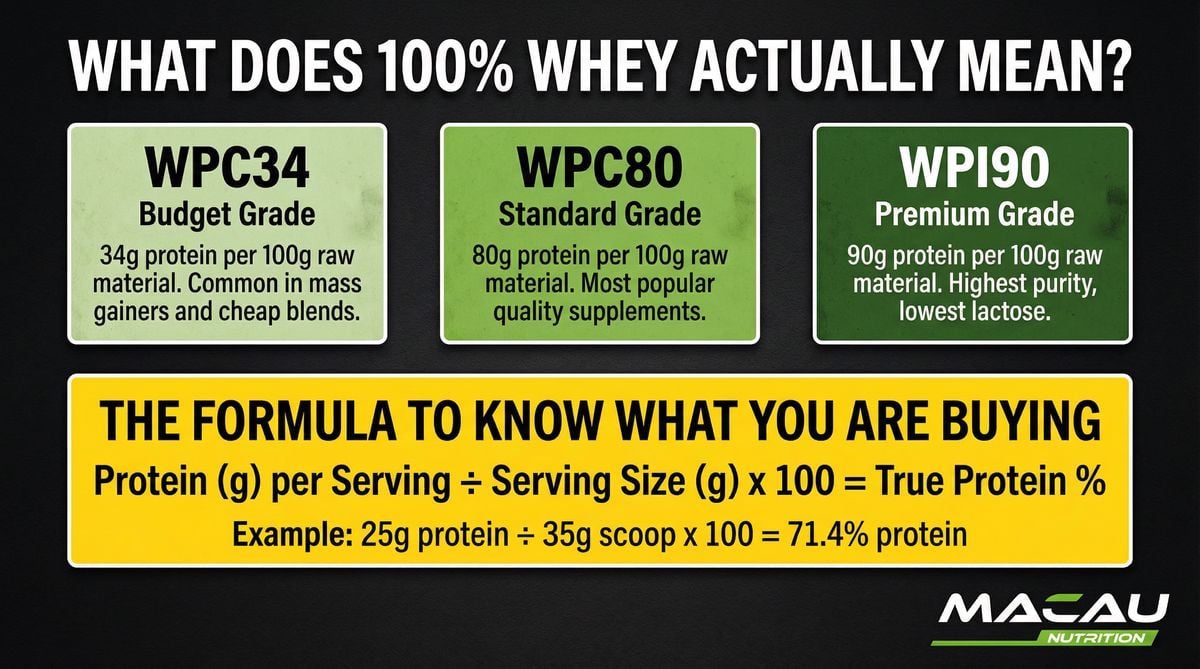
- WPC34 — 34g of digestible protein per 100g of raw material. Commonly used in mass gainers and budget blends.
- WPC80 — 80g of digestible protein per 100g of raw material. The industry standard for quality whey supplements.
- WPI90 — 90g of digestible protein per 100g of raw material. The highest purity grade available.
Think of it like chicken breast. If you eat 200g of cooked chicken breast, you get approximately 40g of protein — not 200g. The food is not 100% protein; it contains water, connective tissue, and other compounds. Whey powder works the same way.
The Formula Every Supplement Buyer Should Know
Before buying any protein powder, flip it over and do this simple calculation:
Protein per serving (g) ÷ Serving size (g) × 100 = True protein percentage
For example: if a product has a 35g scoop and delivers 25g of protein, then 25 ÷ 35 × 100 = 71.4% protein. This works for any protein powder — whey, plant-based, casein, or blended. A quality WPC80 product should score around 75–82%. A WPI90 product should score 88–93%.
Lactose, Galactose, and Who Should Choose Isolate
The real reason to choose WPI over WPC is not marketing — it is biology. Specifically, it is about how your body handles lactose.
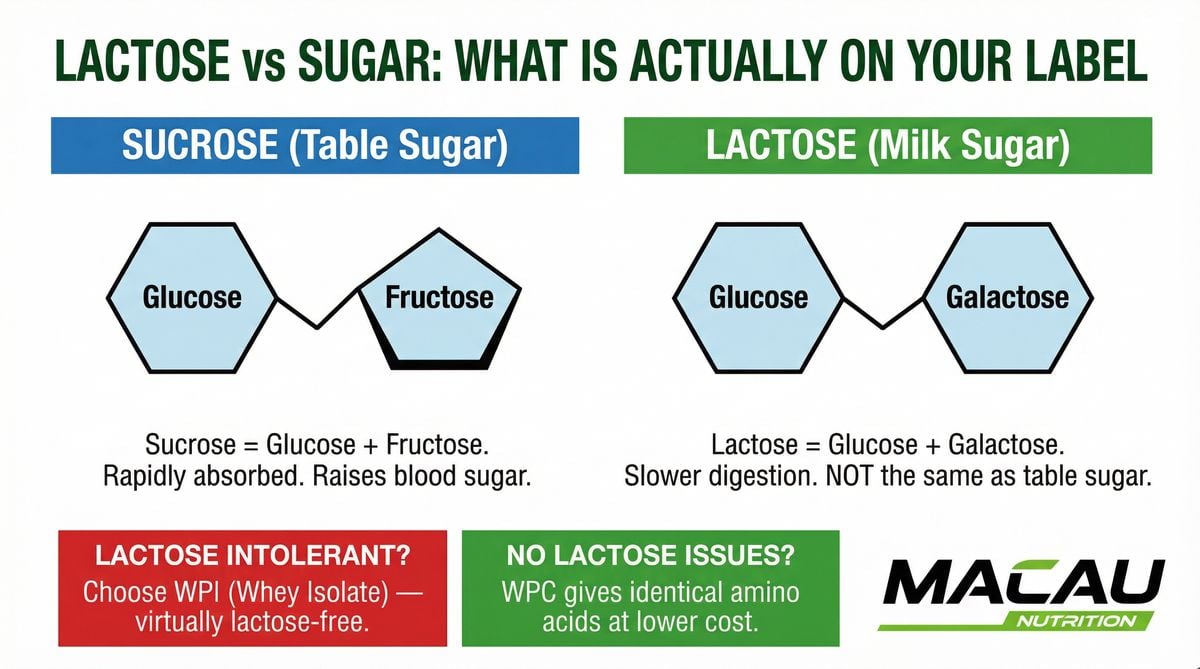
Lactose is the natural sugar found in milk. It is a disaccharide made of two monosaccharides: glucose and galactose. This is completely different from sucrose (table sugar), which is glucose and fructose. The "sugar" listed on a whey concentrate label is lactose — not the same as the sugar in a soft drink.
To digest lactose, your body needs an enzyme called lactase. Most people of Northern European descent produce lactase throughout their lives and have no issue with dairy. However, a significant proportion of East Asian, Southeast Asian, and African populations produce less lactase after childhood — a condition known as lactose intolerance.
If you experience bloating, gas, or digestive discomfort after drinking a whey concentrate shake, lactose is almost certainly the culprit. In that case, WPI is the correct choice — the additional filtration removes nearly all lactose, making it well-tolerated even by most lactose-intolerant individuals.
If you have no digestive issues with dairy, there is no performance advantage to paying the premium for isolate. Save the money and buy a quality WPC80 instead.
Protein Spiking: How to Spot a Scam on the Label
Protein spiking — also called amino spiking or nitrogen spiking — is the practice of adding cheap, non-muscle-building compounds to a protein powder to artificially inflate the protein content shown on the label. It is unfortunately common in the supplement industry, particularly among budget brands.
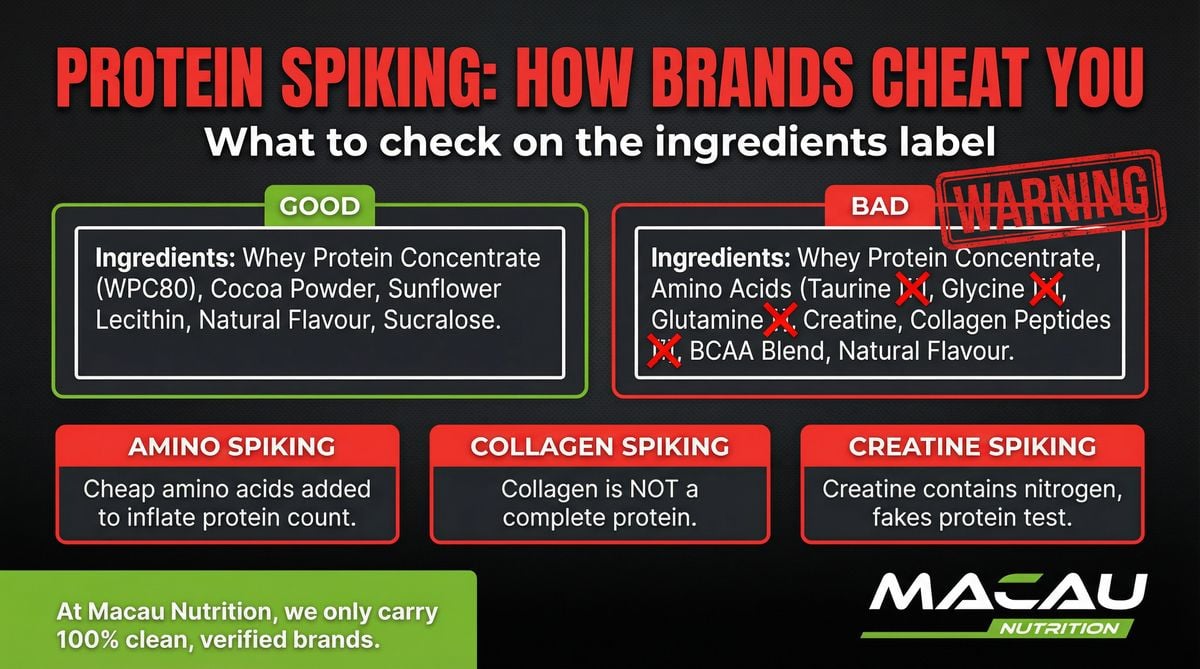
Standard protein testing (the Kjeldahl or Dumas method) measures nitrogen content and converts it to a protein estimate. Certain cheap compounds — taurine, glycine, glutamine, creatine, and collagen — also contain nitrogen. Adding them to a formula makes the protein number look higher than it actually is, while the manufacturer saves money by using less actual whey.
Here is how to protect yourself: read the ingredients list, not just the nutrition panel.
- The first ingredient should be whey protein concentrate or whey protein isolate — ideally with the grade specified (WPC80, WPI90)
- Be suspicious of products that list taurine, glycine, glutamine, or collagen high in the ingredients list alongside whey
- BCAA blends added to a protein powder are a classic spiking signal
- Collagen is not a complete protein and provides no muscle-building benefit when added to whey
At Macau Nutrition, we carefully vet every brand we carry. We do not stock products with spiked formulas, proprietary blends that hide ingredient quantities, or misleading label claims. Every product on our shelves is what it says it is.
The Bottom Line: What to Actually Buy
Here is a simple decision framework for choosing the right whey protein:
- No lactose issues? Buy a quality WPC80. Check the label — protein per serving ÷ serving size should be 75–82%. It will give you identical muscle-building results to isolate at a lower price.
- Lactose intolerant or sensitive to dairy? Buy a WPI90. The extra filtration removes nearly all lactose. Check the label — protein per serving ÷ serving size should be 88–93%.
- Always check the ingredients list. Whey (WPC or WPI) should be the first ingredient. If you see a long list of amino acids, creatine, or collagen alongside whey, put it back.
- "100% Whey" is a source claim, not a protein content claim. Do the maths on the label every time.
Whey protein is one of the most effective, well-researched, and safe supplements available. When you buy a quality product from a trustworthy source, it genuinely supports muscle recovery, protein synthesis, and overall body composition goals. The key is knowing how to read the label — and now you do.
Browse our full range of quality whey protein supplements at macaunutrition.com or visit our stores in Macau and Taipa.